
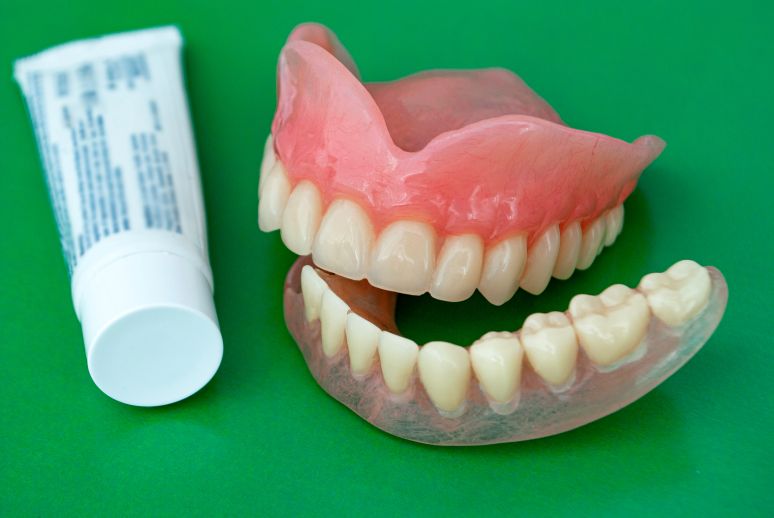
Your dentures should easily stay in place in your mouth simply by using natural suction. However, as they get older, these restorations can change shape, as can your mouth, causing them to lose their fit. The good news is that denture adhesives can help hold them steady until they can be repaired or replaced. Here’s a closer look at three popular types of denture adhesive and how to use them to temporarily get a secure fit for your smile!
Decisions, Decisions… How to Choose the Right Denture Adhesive
When it comes to picking a denture adhesive, the good news is that most products do an excellent job delivering a secure hold for your prosthetics. Ultimately, the exact type you choose boils down to a matter of personal preference, whether it’s determined by price, ease of use, or even mouthfeel. Here’s a closer look at some of the options.
Denture Adhesive Powder
Denture adhesive powder sprays out of an aerosol can and is often easier to manipulate for patients with dexterity issues. It also provides greater control over the amount of product used, so it creates less waste, saving you money. To use powdered adhesive:
- Using clean dentures, rinse them well but do not dry them off.
- Carefully cover the denture by spraying a thin coat of adhesive powder along only the surfaces that will touch your arches and the roof of your mouth.
- Moisten your mouth with water.
- After applying, Gently shake the denture to remove excess powder from your restorations.
- Place the denture in your mouth and bite down on it to secure it in place.
Denture Adhesive Cream
Denture adhesive cream is probably the most convenient bonding product to use, because it already comes pre-mixed and only needs to be squeezed out of a tube, just like toothpaste. However, because of this, it can often be the most expensive choice.
- Using clean, dry dentures, apply the adhesive directly to the inside surface of the prosthetic in short stripes. Be careful not to use too much product, as it can overflow and ooze into your mouth when you put it on.
- Moisten your mouth with water.
- Press your denture into your arches and keep it there for a few seconds to allow it to attach.
Denture Adhesive Strips
Denture adhesive strips are very customizable because they can be trimmed and placed exactly where you want them. They come dry, but can be activated with regular tap water.
- Using clean, dry dentures and hands, take the adhesive strips out of their packaging and wet only the ones you’ll be using with water.
- Next, attach each strip one at a time to the denture. Be sure to avoid the edges of the denture, and don’t overlap the strips.
- Moisten your mouth with water, press the denture in place, and bite down for several seconds to completely secure it.
Don’t Stick Around: Removing Denture Adhesive from Your Restorations
Because you should be removing your dentures before you go to bed each night, it is important to clean them properly, so they don’t trap harmful bacteria and food debris in your smile. Thus, if you’ve been using denture adhesive, it is very important to remove it all when you take your dentures out. Here’s how to do it:
- Swish around some warm water in your mouth, and then gently pull your dentures out and place them somewhere safe.
- Next, brush your gums with a soft bristled toothbrush and toothpaste to clear away any adhesive residue, bacteria, and food from your mouth.
- Using a different soft-bristled toothbrush, carefully scrub your entire denture with either a mild hand soap or denture cleanser. Floss between every tooth and rinse your restoration well.
- Once clean, carefully place your dentures in a glass of water or denture soak overnight.
It is important to note that dentures should be able to stay in place with natural suction. However, if they ever do not, denture adhesives can provide a secure, temporary hold until you can see your dentist for help. Please be aware that denture adhesives often contain zinc, which can be dangerous in large quantities. That’s why it is important to only rely on them as a short-term solution, and if your restorations aren’t fitting the way that they should, it’s time to discuss a reline or a new denture with your dentist.
About Dr. Cochell
Dr. Christel Cochell earned her undergraduate degree at Oregon State University and her dental degree at OHSU in Portland. Today, she is proud to offer a variety of smile-saving oral health treatments including dentures in her own practice. Dr. Cochell is member of the American Dental Association, the Oregon Dental Association, and the Seattle Study Club. To schedule an appointment for dentures at Cochell Family Dentistry, visit our website or call us today at 503-585-8688.